Steve Jobs's 10-80-10 rule : a guide to AI product management.

Hugo Chamberland
5 min
In 2026, most product teams have integrated AI into their execution workflow. Fewer have defined who sets the direction before the AI runs, and who checks the output after.
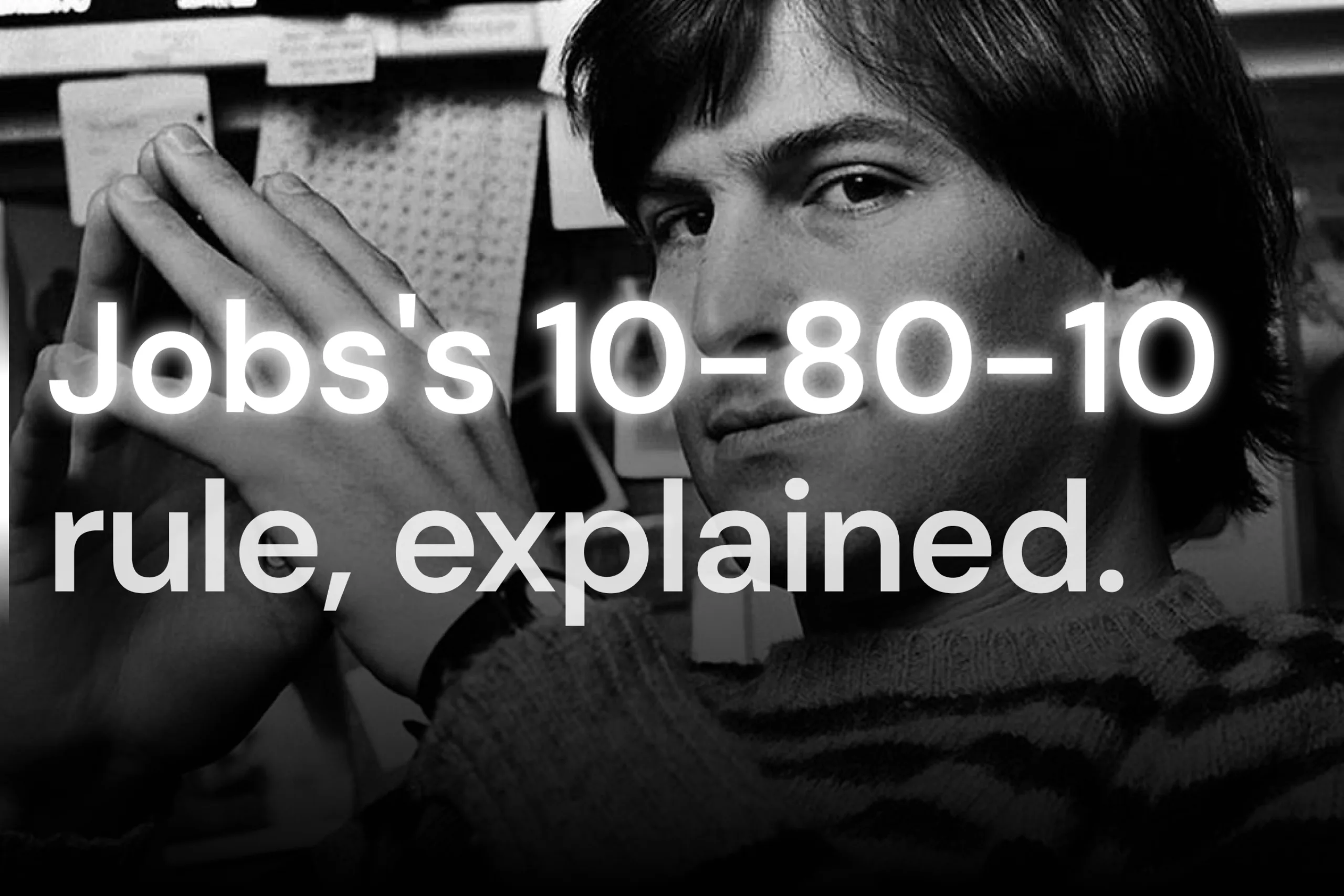
The 10-80-10 rule, which Steve Jobs applied to managing human teams, maps directly onto this problem. Spend 10% setting direction. Let the middle 80% run. Spend 10% verifying and polishing the output. AI can take the middle. But if nobody frames the first 10% and nobody owns the last 10%, accelerating the execution accelerates the mistakes too. A 2026 survey cited in Business Insider found that 92% of users do not check the work produced by AI. For a product team shipping features on an AI-assisted workflow, that number is not a statistic. It is a governance gap.
How Steve Jobs learned to let go of the middle
Steve Jobs was a micromanager early in his career. Andy Hertzfeld, a member of the original Macintosh team, described bringing Jobs an early demo of the calculator interface and watching him reject every detail: the background color, the line thickness, the button size. The team iterated repeatedly without satisfying him, until an engineer built a tool that let Jobs configure every parameter himself. Jobs played with the menus, settled on a design he liked, and that design remained the standard Mac calculator for years.
By 2010, Jobs described his management style very differently. Teamwork, he said, depends on trusting others to come through without watching them all the time. If you want to hire great people and have them stay, you have to let them make decisions. The micromanager had become a leader who set the direction, trusted the execution, and came back hard on quality at the end.
That shift is the 10-80-10 rule in practice. Not a framework imposed from outside, but the natural evolution of a leader who understood that their value was not in the execution. It was in the clarity of the starting point and the rigor of the final check. Jessica Stillman, writing on AI product management, argues that this structure applies directly to how teams should work with AI today. The numbers are not exact, but the logic is sound.
The 80% that AI can own
What is the 10-80-10 rule and how does it apply to product management? The middle 80% is the execution layer: first drafts, boilerplate, test generation, documentation, pattern recognition in product data. This is the layer AI handles well when the input is clear and the output criteria are defined. A product team that has integrated AI into this layer moves faster. Features ship in days rather than weeks. The backlog clears.
The problem is not in the 80%. European product teams that have adopted AI in their execution workflow report meaningful velocity gains on tasks with clear parameters. The problem is in what surrounds it. AI product management requires the same structure as managing a high-performing human team: a clear brief at the start and a rigorous review at the end. Without both, the speed of the middle becomes a liability rather than an asset.
The brief is the 10% that defines what the build must prove, which user it addresses, and what success looks like before anyone writes a line of code. The review is the 10% that checks whether the output holds against that definition. Skip either one and the 80% in the middle produces something fast that may or may not be right.
The 10% that nobody is doing
How do you maintain quality control when using AI in product development? The honest answer is that most teams do not. The output of an AI-assisted workflow looks finished. It is clean, structured, and plausible. That appearance of completion is exactly what makes the final 10% easy to skip. An output that already looks done does not invite a second look.
For a Head of Product, the cost of skipping the last 10% is specific. Features ship that engage without converting. Roadmap decisions are made on outputs that were never checked against the original brief. The team is moving fast, but the metrics that matter, retention, expansion, revenue, do not move with it. The gap between velocity and impact widens, and the Head of Product cannot explain it to the CEO or the board because the brief that would have defined success was never written in the first place.
Structuring the first 10% is the intervention that makes the last 10% possible. When the outcome is defined before the build starts, verification is not a judgment call. It is a check against a standard that already exists. That is what product discovery at Nightborn is designed to produce: a defined outcome for every build, written before execution begins, that gives the Head of Product something concrete to verify when the work comes back.
What Nightborn structures around the 80%
The model Nightborn works from is built around the 10% that surrounds the execution. Before writing a line of code, Nightborn works with the Head of Product to define what the build must prove and what the verification criteria look like. After delivery, the transfer includes not just the code but the documentation of the decisions made during execution, so the internal team can check the output against the original intent.
This is what makes AI integration at Nightborn different from a standard development engagement. The 80% of execution is faster because the 10% of framing was done properly. And the last 10% of verification is possible because the first 10% produced something to verify against.
The Head of Product who works this way ships fewer features that miss their target. They also have something Jobs spent decades learning to build: a team that moves fast because the direction is clear, not because the oversight has been removed.
If your team is shipping faster but your features are missing their targets, the gap is probably not in the execution. It is in the 10% that nobody owns. The way Nightborn structured this with Skipr over four years, maintaining execution speed while keeping every build accountable to a defined outcome, is worth reading if you are trying to close the same gap. The full case is there.